Harmonies!
José Rodríguez Alvira
Neapolitan Sixth
Traditional use of the Neapolitan sixth:
The Neapolitan sixth chord (N6) is an altered second-degree chord in first inversion that leads to the dominant of the key. Structurally, it is a major chord in first inversion that is a semitone above the tonic. There are three commonly used patterns:
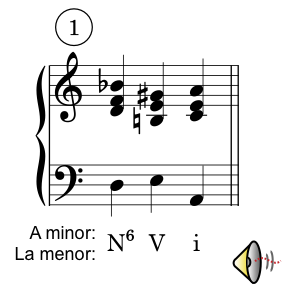
The Neapolitan sixth resolves to the dominant chord.
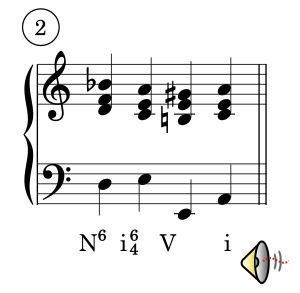
A tonic chord in second inversion (or, if you prefer, a dominant chord with a sixth and fourth appoggiaturas) precedes the dominant.
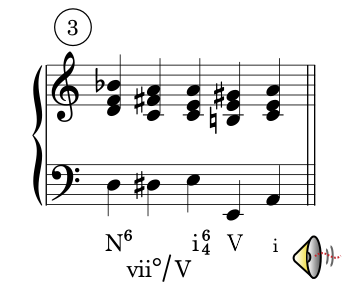
A vii-degree chord of the dominant is added to prepare for the dominant.
Below, we present some exceptional examples of the use of this chord.
Bach
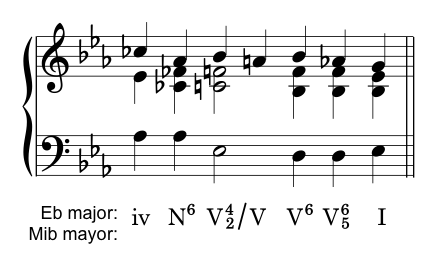
Let’s look at Bach’s original use of this chord in the Prelude from the Prelude, Fugue, and Allegro, BWV 998..
- The passage is in E-flat major.
- We begin on the tonic and, via a secondary dominant, arrive at the minor IV degree (A-flat minor) in measure 37.
- Measure 39: This A-flat minor chord leads into the Neapolitan sixth chord in first inversion (F-sharp major).
- Measure 40: Unexpectedly, the Neapolitan sixth resolves to the dominant of the dominant in third inversion.
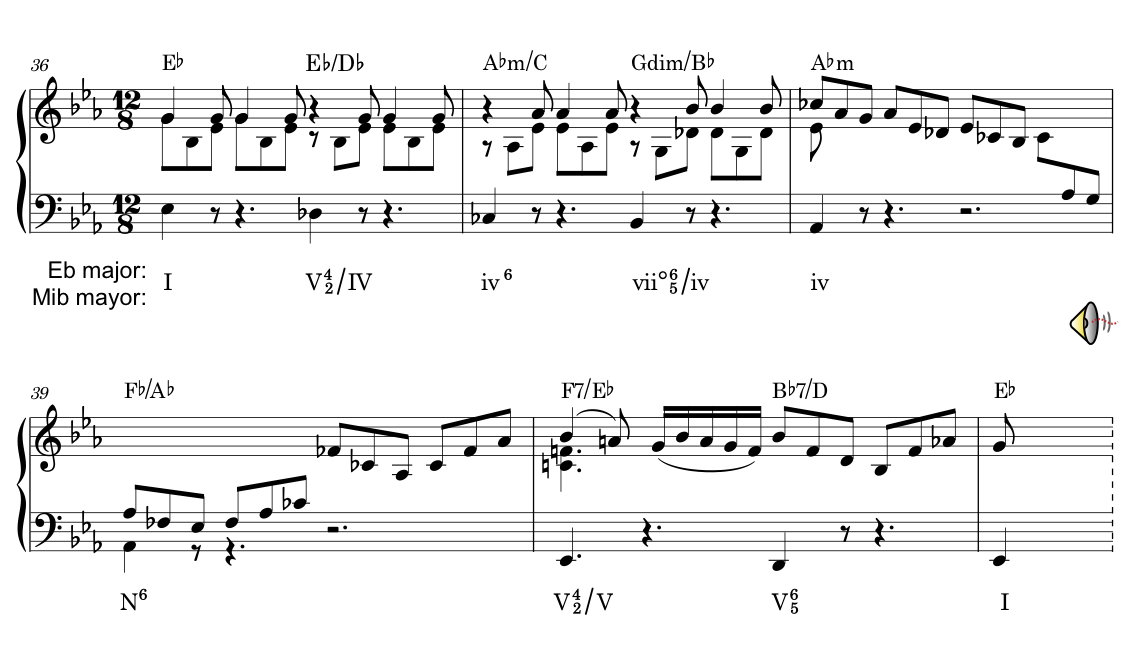
J. S. Bach, Prelude, Fugue and Allegro BWV 998, Prelude
Here are the chords:
Beethoven
This is a passage from Beethoven’s Third Symphony:
- We begin in E minor with a diminished seventh chord that seems to lead us to the dominant of E minor.
- Measure 274: It leads to the VI degree (C major) via a common note (C).
- Measure 276: The C major chord resolves to F major in first inversion with a major seventh (E, in red). This F major is a Neapolitan sixth from E minor with an added major seventh.
- Measure 278: Beethoven insists on the Neapolitan sixth with a major seventh. The brass plays the major seventh.
- Measure 280: We arrive at the dominant of E minor with a minor ninth.
- Measure 283: Resolution to E minor.
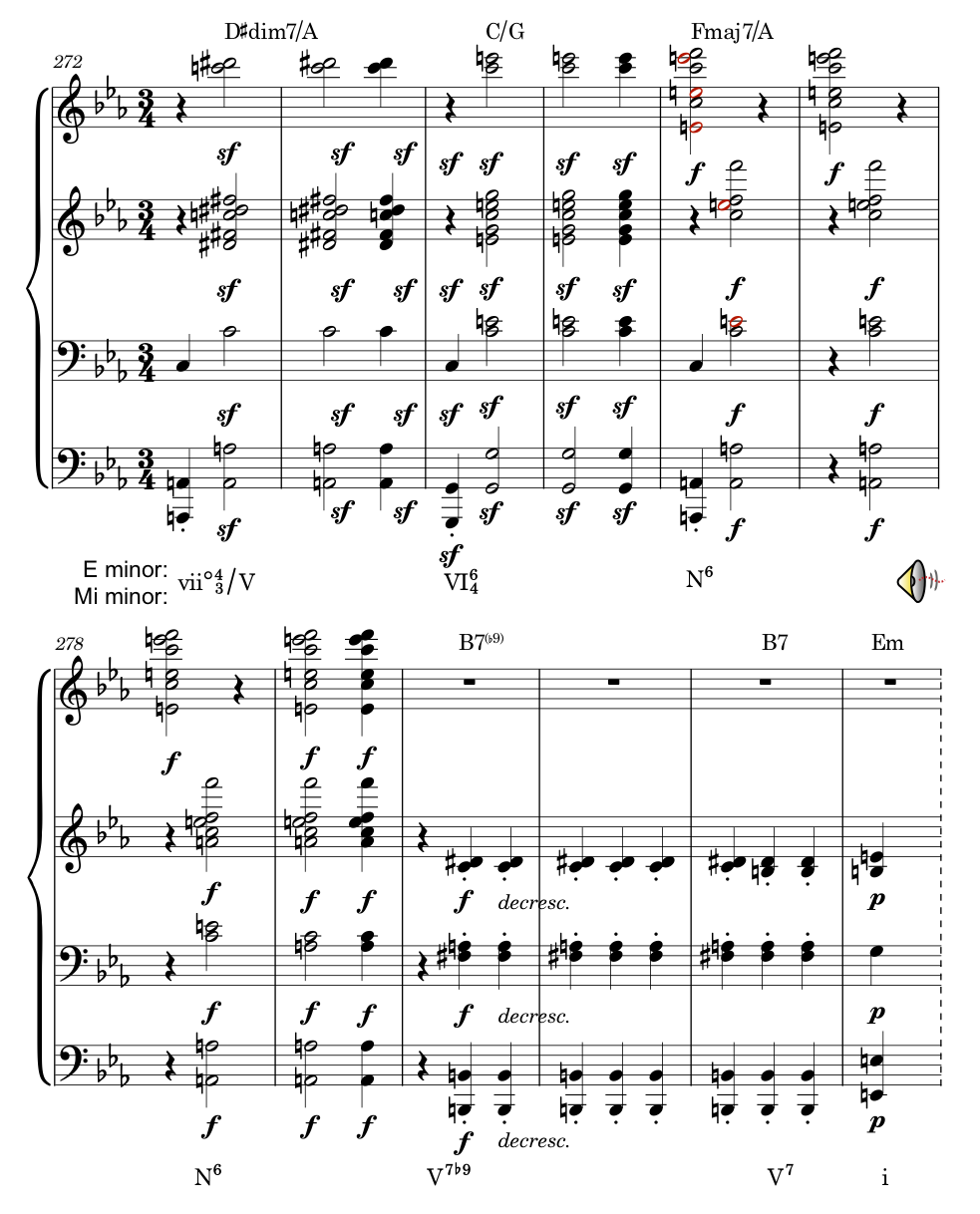
Beethoven, Third Symphony, first movement
Wagner
In the Prelude to the first act of Tristan and Isolde, Wagner uses the Neapolitan sixth in a very interesting way:
The E-flat should lead to the C-sharp (in blue), but Wagner inserts two Ds and an E (in red) before reaching the C-sharp.
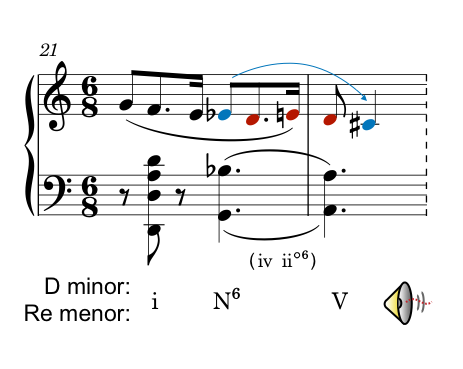
Wagner, Tristan and Isolde, Prelude to the first act
The resolution from B-flat minor to E-flat major in the sixth Neapolitan cadence typically creates direct fifths that are not effective. Wagner saves the day thanks to his ingenious melodic movement.

This work is licensed under a Creative Commons Attribution-NonCommercial-NoDerivatives 4.0 International License. José Rodríguez Alvira.
Published by teoria.com
