Harmonies!
José Rodríguez Alvira
Blues Harmonies
The basic structure of the blues consists of 12 measures. Its harmony is based on the tonic, dominant, and subdominant chords, all of which are dominant seventh chords:
| Measure | 1 | 2 | 3 | 4 | 5 | 6 | 7 | 8 | 9 | 10 | 11 | 12 |
| Chord | I7 | IV7 | I7 | V7 | I7 | V7 | ||||||
Almost all the chords in this progression can be explained using traditional harmony. The V7 leads to the I, and the I7 leads to the IV. We have more trouble explaining the IV7. Taking the key of C major as a reference, a IV7 would be the dominant chord of B-flat, a chord that does not exist in the key of C major.
Bach
Bach, in his Brandenburg Concerto No. 6, surprises us with precisely this chord. We are in B-flat major. On the second beat of measure 27, we encounter an E-flat dominant chord (we’ve marked the D-flat in red). This chord—the dominant of A-flat—leads us, however, to the V degree in a manner similar to what happens in the blues:
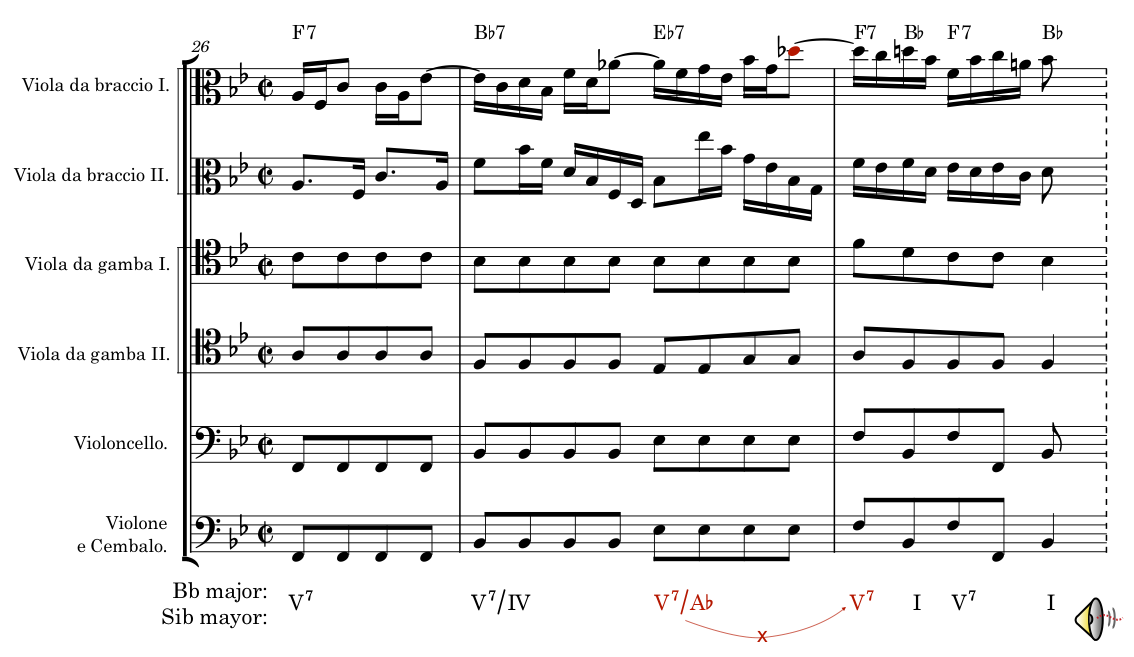
Bach, Brandenburg Concerto No. 6, first movement
Explanation
In minor keys, we sometimes find a IV-degree chord as a dominant seventh that leads to the V degree:
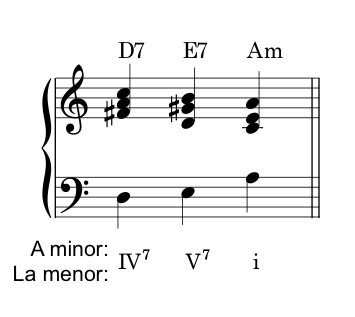
In a minor key, when using the melodic minor scale, we find the F-sharp in the IV-degree chord with a dominant seventh. In other words, the D dominant from the previous example does not function as the dominant of G, but rather as a subdominant that leads us to the dominant.
Therefore, we can explain the dominant over the IV degree that we see in the Brandenburg Concerto as a subdominant resulting from modal transformation (borrowed from the minor key) that leads us to the dominant. However, despite this explanation, the passage still has a subtle bluesy flavor.

This work is licensed under a Creative Commons Attribution-NonCommercial-NoDerivatives 4.0 International License. José Rodríguez Alvira.
Published by teoria.com
