Harmonies!
José Rodríguez Alvira
Augmented Sixth Chords
Augmented sixth chords are altered chords that resolve to the dominant. Traditionally, there are three variants commonly known as the Italian (I6), French (F6), and German (G6).
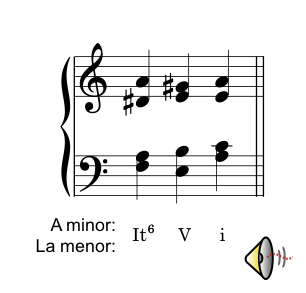
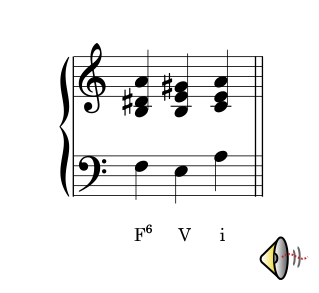
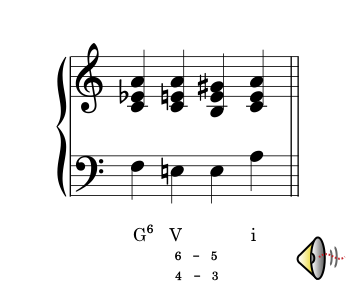
They all share the augmented sixth interval (F–D# in the examples above), which resolves to the root of the dominant chord.
Chopin
In Prelude No. 8, Chopin arranges dominant seventh chords in a descending chromatic sequence:
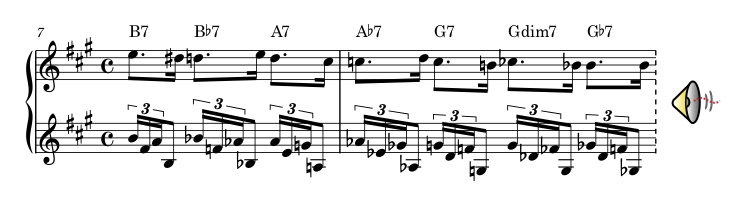
Chopin, Preludio no. 8
How can we explain this? We’ll use the second and third chords in the series to explain it:
- A dominant seventh chord can be written as a German augmented sixth (G6) by enharmonically changing its seventh (in the case of a B-flat dominant, from A-flat to G-sharp; see 1 in the image).
- In number 2 of the image, we see the augmented sixth chord resolving to the dominant, in this case D minor. The augmented sixth interval (B-flat–G-sharp) resolves to the root of the dominant chord (A).
- In Romantic-era music, there are numerous examples in which the augmented sixth descends to find the seventh of the dominant chord.
- In his prelude, Chopin writes all the chords as dominants, and the result is a series of dominant seventh chords that descend chromatically.
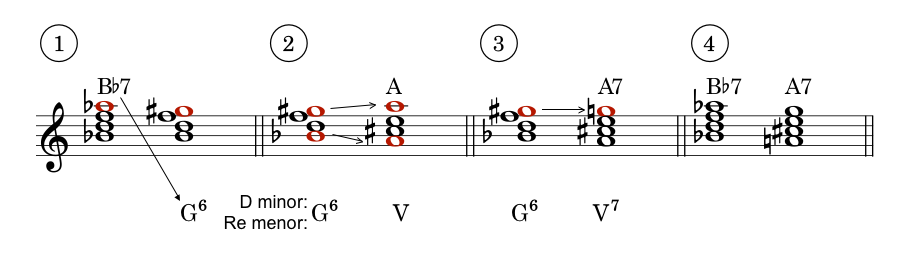
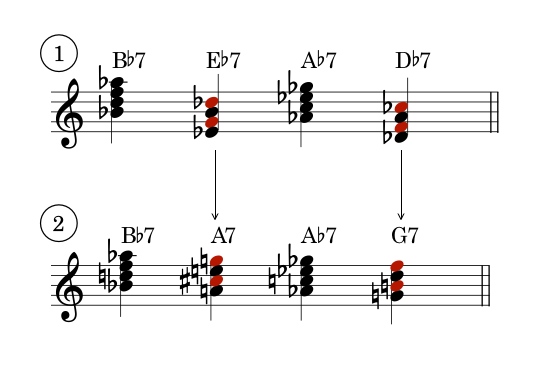
Jazz theory offers us another explanation:
- We start with a traditional series of fifths (1).
- We substitute every other chord using the tritone substitution. This procedure states that we can substitute a dominant chord for another that contains the same tritone. In this case, we have substituted Eb7 for A7 (G–Db => C#–G) and Db7 for G7 (F–Db => B–F). The result is a series of dominant seventh chords that descend chromatically.
Wagner
In the second measure of the Prelude to the first act of Tristan und Isolde, we find a chord (shown in red in the image below)—known as the Tristan chord—that has sparked numerous debates:
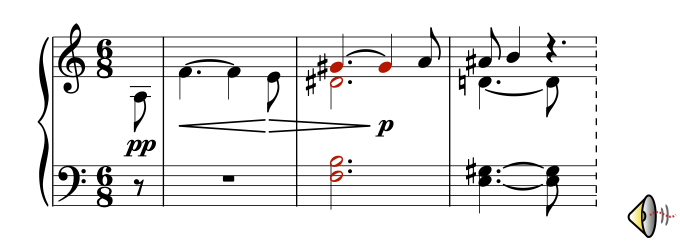
Wagner, Tristan and Isolde, Prelude to the first act
How can we analyze this chord?
The chord (see 1 in the image below) sounds similar to a half-diminished seventh chord (2). In reality, the G# is a long appoggiatura that resolves at the very last moment to the chord’s true note: A. It is a French augmented sixth chord (3). In 4, we can see how it would traditionally resolve: the augmented sixth F–D# opens to the octave E–E of the dominant chord:
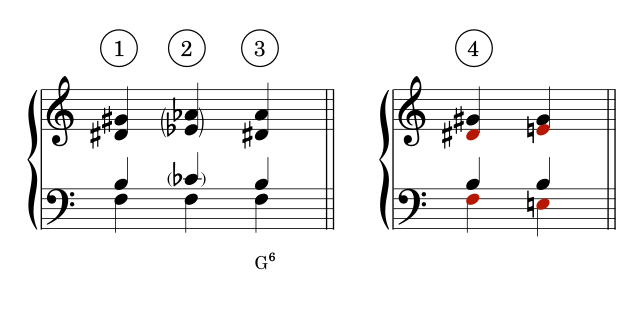
What does Wagner do?
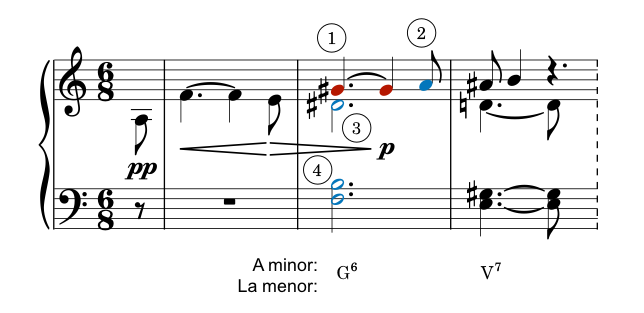
Wagner, Tristan and Isolde, Prelude to the first act
- The G♯ is a long appoggiatura of the chord’s actual note: A
- The A in the augmented sixth chord should resolve to the third of the dominant chord; however, it moves chromatically to reach the fifth (B).
- The D♯ should resolve to the root of the dominant chord but descends to the seventh of the dominant chord.
- The B should remain to form the fifth of the dominant chord, but it is forced to descend to the third.
This unusual way of resolving the augmented sixth chord is effective thanks to the ingenious melodic movement of the voices.

This work is licensed under a Creative Commons Attribution-NonCommercial-NoDerivatives 4.0 International License. José Rodríguez Alvira.
Published by teoria.com
