Harmonies!
José Rodríguez Alvira
Polychords
A polychord is the superimposition of two or more chords. It is characteristic of 20th-century polytonal music. A clear example can be found in Stravinsky’s The Rite of Spring:
- The second violins and violas repeat a dominant E-flat chord in first inversion.
- The cellos and double basses play an Fb major chord.
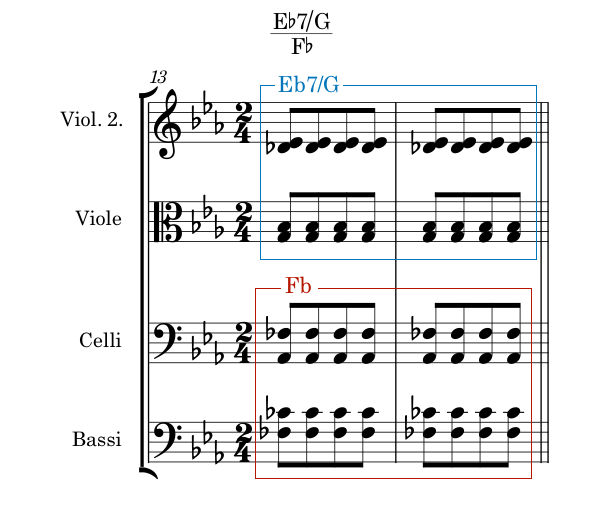
Stravinsky, The Rite of Spring, Dance of the Adolescents
Beethoven
We have reached the end of the development section as Beethoven prepares the recapitulation of the first movement of his Third Symphony.
- Starting in bar 389, we encounter an B-flat dominant chord.
- In bar 394, the horn enters with the main theme: an E-flat major arpeggio (tonic).
- This creates a superimposition of chords, or a polychord: E-flat (tonic) and B-flat (dominant).
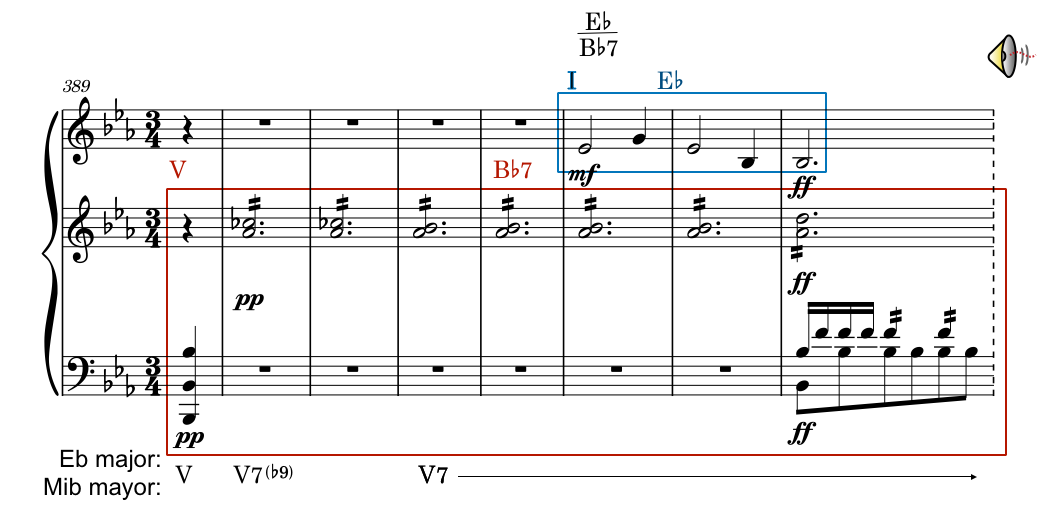
Beethoven, Third Symphony in E flat major, first movement
Bach
Cantata Himmelskönig, sei willkommen, BWV 182, aria Jesu, laß durch Wohl und Weh
- We are in F-sharp minor.
- In measure 44, the Neapolitan sixth of the key (G major) appears.
- The continuo (lower staff) features a B-sharp, which could be the root of the VII chord of the V chord or the third of the dominant of the dominant. Although the other notes of the chord are not present, the B-sharp strongly suggests the function of a secondary dominant chord.
- We therefore have a chord superposition or a polychord: G major (Neapolitan sixth) and diminished B-sharp.
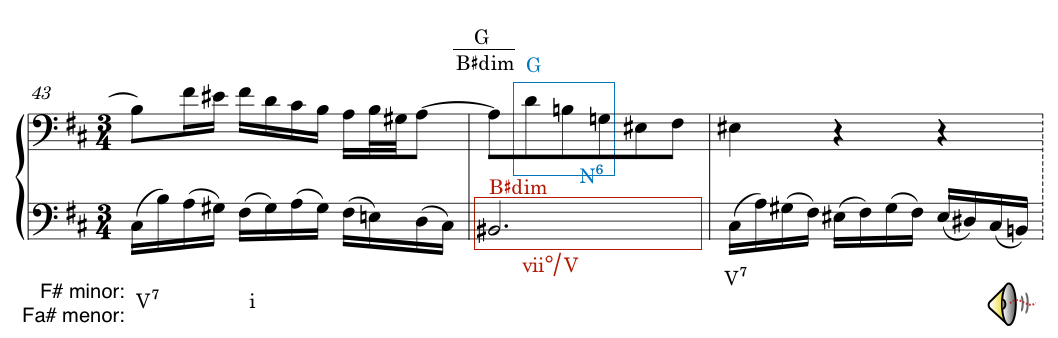
Bach, Cantata Himmelskönig, sei willkommen, BWV 182, aria Jesu, laß durch Wohl und Weh
We would like to thank Pedro Segarra Sisamone for showing us this example.

Esta obra está bajo una Licencia Creative Commons Atribución-NoComercial-SinDerivar 4.0 Internacional. José Rodríguez Alvira.
Publicado por teoria.com
