Harmonies!
José Rodríguez Alvira
Whole-tone Scale
The whole tone scale comprises six notes, each of which is separated by a tone. This scale is also known as the hexatonic scale.
This scale began to be used in the late 19th century. Numerous examples of its use can be found in Debussy's music:
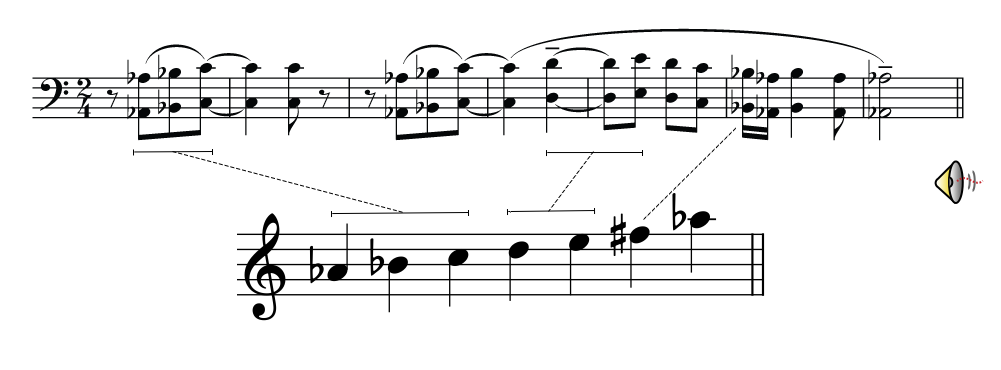
Debussy, Prelude II, ...Voiles, measure 7. C. Coleman, piano, Courtesy of Piano Society
Can we find examples from the Baroque, Classical, or Romantic periods?
Mozart
Here we see the final measures of the violin Cadenza in Mozart's A Musical Joke, K. 522, where we find the whole-tone scale:
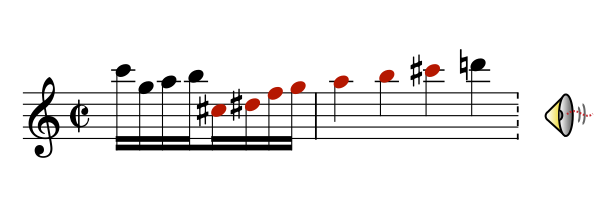
Mozart, A Musical Joke
It goes without saying that it's a musical joke.
Chopin
Looking at the bass line in this passage from Chopin's Prelude No. 19, we can see the whole-tone scale (marked in red):
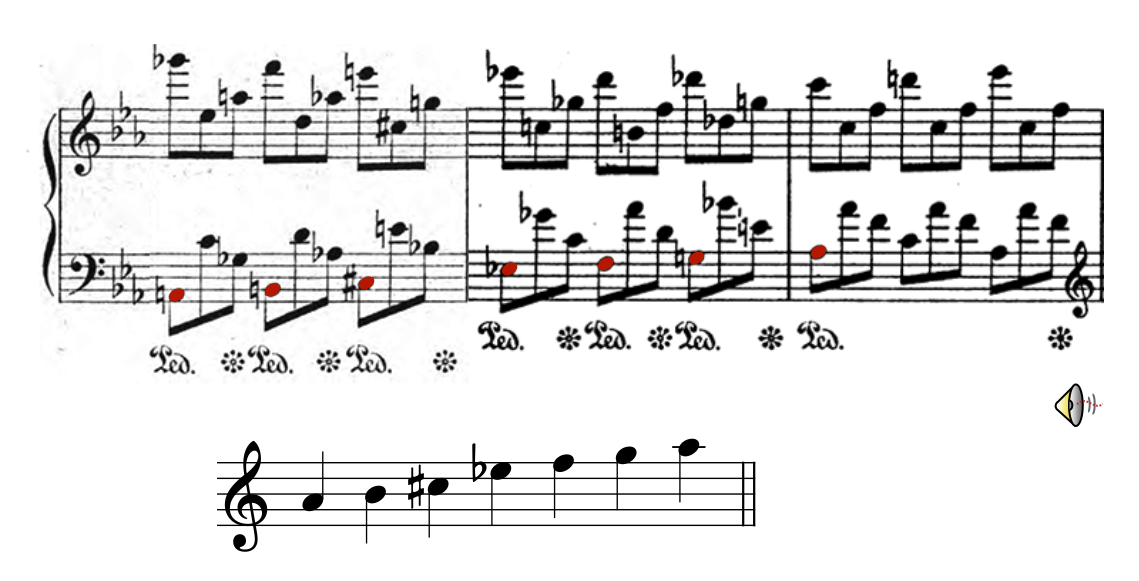
Chopin, Prelude No. 19, measure 43. Jeannette Fang, piano, Courtesy of MUSOpen
This scale is the result of a series of diminished seventh chords. In the right hand, they descend chromatically; in the left hand, they ascend by whole tones, forming the whole-tone scale (see analysis of the complete prelude).
Neither of the two examples can be said to use the scale systematically as a musical device. However, it is present in both passages.

This work is licensed under a Creative Commons Attribution-NonCommercial-NoDerivatives 4.0 International License. José Rodríguez Alvira.
Published by teoria.com
