Harmonic Functions : Building an Augmented Sixth Chord
First, we will transform the iv degree chord of the A minor key into an augmented sixth chord.
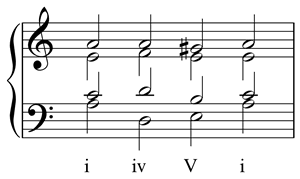
 Below is the i - iv - V - i progression in A minor:
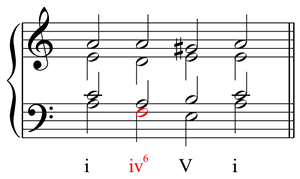
 Now, we set the iv degree chord in first inversion:
 By raising the root of the IV degree chord by a semitone (D♯ in this case), we get an augmented sixth chord:
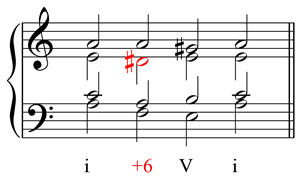
This chord is called an augmented sixth chord because there is an augmented sixth interval between the bass note and the note that has been raised by a semitone. Raising this note increases harmonic tension. The augmented sixth interval resolves by moving the higher note up by half a step (D# to E) and the lower note down by half a step (F to E). Listen to both examples:
|
 |
|
|
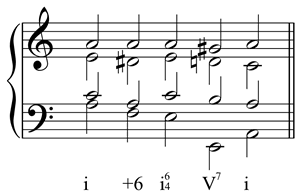
The augmented sixth chord is very often followed by the tonic chord in second inversion (or, if you prefer, a dominant chord with 6th and 4th appoggiaturas) before resolving to the dominant chord:
 |
|

