Prelude No. 9 in E Major, Measures 5 to 8
José Rodríguez Alvira
Second phrase, measures 5 to 8
The harmonic scheme becomes more interesting in the fifth measure:
| Measure 5, 2nd and 3rd beat | The V degree chord of E major is followed by a G major chord. G major is the third degree of E minor (modal interchange). |
| Measure 5, 4th beat | G major is used as a dominant chord. |
| Measure 6 | C major is used as an F major chord and it is followed by a G minor chord (2nd beat) before the F major dominant chord reappears in the 3rd measure. |
| Measure 7, beats 1 and 2 | The dominant chord of F major resolves to an A major chord, which is used as the V degree of the D minor key, followed by a vii degree chord. |
| Measure 7, beats 2 and 4 | The vii degree of D minor (C# - E - G - Bb) is used as the vii degree of Ab major (G - Bb - Db - Fb), followed by the ii and vii degrees of Ab major. |
| Measure 8 | The cadence moves to the key of Ab major (3rd beat). The Ab major chord transforms into an Ab minor chord, which is used as the E major iii chord (Ab = G#), followed by an E major dominant chord. |
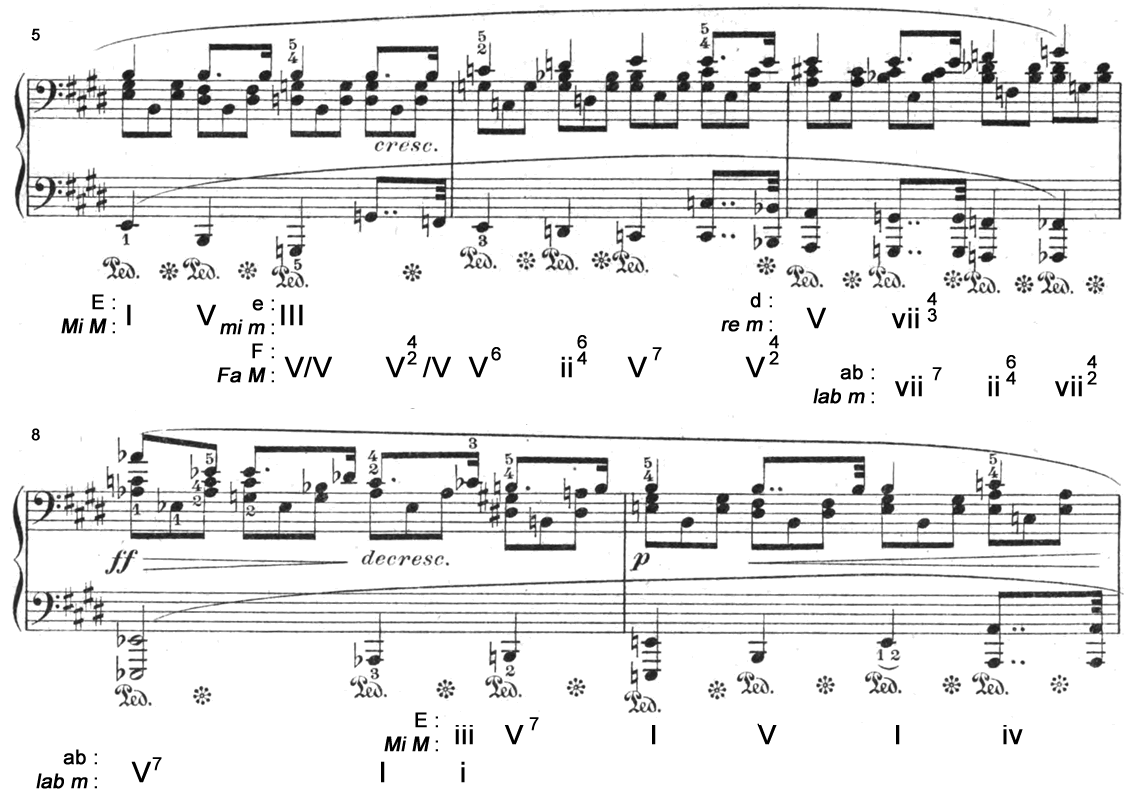
Chopin uses three modulation methods in these four measures:
Modal interchange - using a chord from the parallel minor key. G major is the III degree chord of E minor and is used as the V/V chord of F major. Modal interchange is also used to transform the Ab major chord into an Ab minor chord (G# minor), which allows it to be used as an E major chord of the third degree.
Irregular resolution or common tone - where the F major dominant chord is followed by an A major chord (both chords share the note E).
Diminished chord - The D minor vii chord (C# - E - G - Bb) is used as Ab's vii degree (G - Bb- Db - Fb). Db = C# and Fb = E.
© 2018 José Rodríguez Alvira. Published teoria.com
